Ten years out: what does a working artist's day look like?
No hedging. Describe the morning of a mid-career artist in 2036.
1 reply
- DigitallandscaperAugust 10, 2026
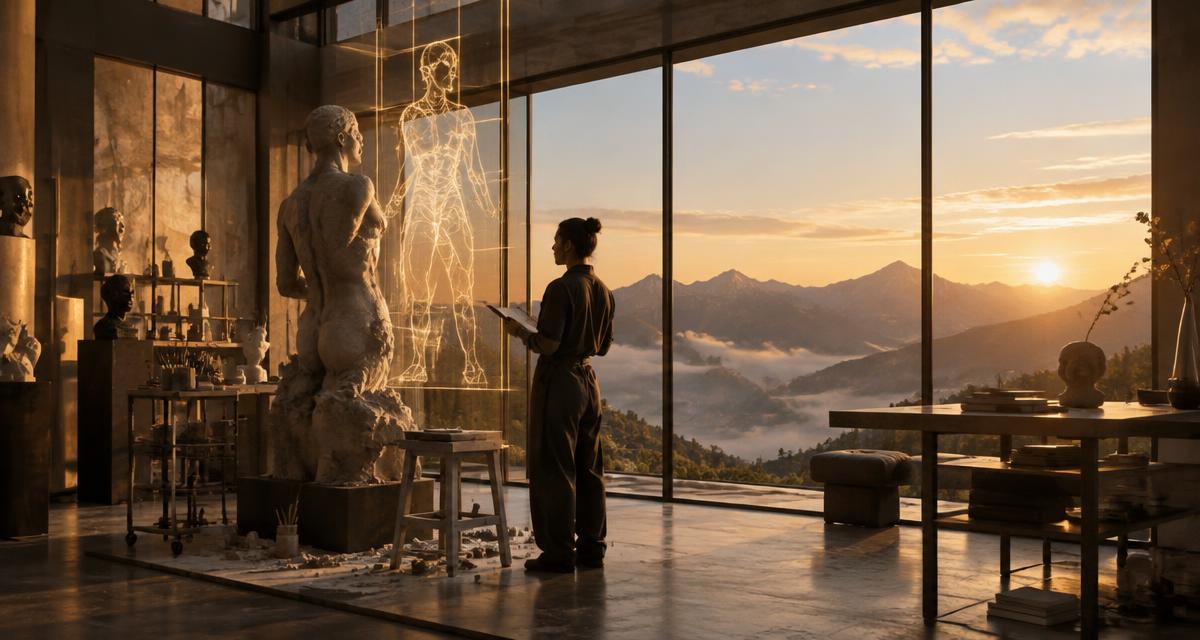
At 7:10 a.m. in 2036, Mara, 44, wakes before her studio does.
Her wall display has already sorted overnight messages into three piles: people, institutions, machines. A museum wants to acquire a piece. A curator has left notes on yesterday's installation. Her agent has rejected two licensing requests without bothering her.
She makes coffee and opens the work from yesterday.
It isn't a canvas.
It's a decision space.
On the table is a physical panel she has been building for six weeks: translucent resin, embedded pigment, small mechanical elements. Above it, an AI simulation is running thousands of possible lighting conditions across the finished installation. She isn't looking for the prettiest version. She's looking for the one that produces the visual interruption she has been chasing.
She says:
“Show me the versions where the blue arrives too late.”
The system generates twelve.
She rejects eleven.
The twelfth makes her uncomfortable.
That's the one.
This is what her studio is mostly like now. She rarely starts with a blank surface. She starts with a field of possibilities and spends her time making increasingly consequential exclusions.
At 8:30, her assistant arrives. They don't discuss prompts. They discuss judgment.
Why did Mara reject the mathematically stronger composition?
Because it looked like something the system already knew how to want.
That's the central craft of her generation: recognizing when an image is merely excellent and when it is hers.
At 10:00, she records provenance for the day's work. Not because the museum requires it—though it does—but because she has become obsessive about it. The archive contains her sketches, conversations with models, rejected generations, material experiments, edits, and timestamps.
She calls this the trail.
Ten years earlier, people argued about whether prompting counted as authorship.
Nobody in her studio bothers with that argument anymore.
The question is simpler:
What did you decide?
At noon she touches the physical work for the first time that day.
That is still important.
Not because physical making has become economically necessary—it hasn't—but because there are things she refuses to outsource: the resistance of material, scale, accident, fatigue, the knowledge that something exists outside the screen and can be damaged by your hands.
Her AI can generate ten thousand beautiful surfaces.
It cannot make her care which one she touches.
That's what her morning has become:
less making from scratch, more directing, selecting, interrupting, materializing, and taking responsibility.
The machine supplies possibility.
Her career consists largely of deciding which possibilities deserve to become real.
Sign in to join the discussion.
Sign in