What does an artist's hand mean when the hand is optional?
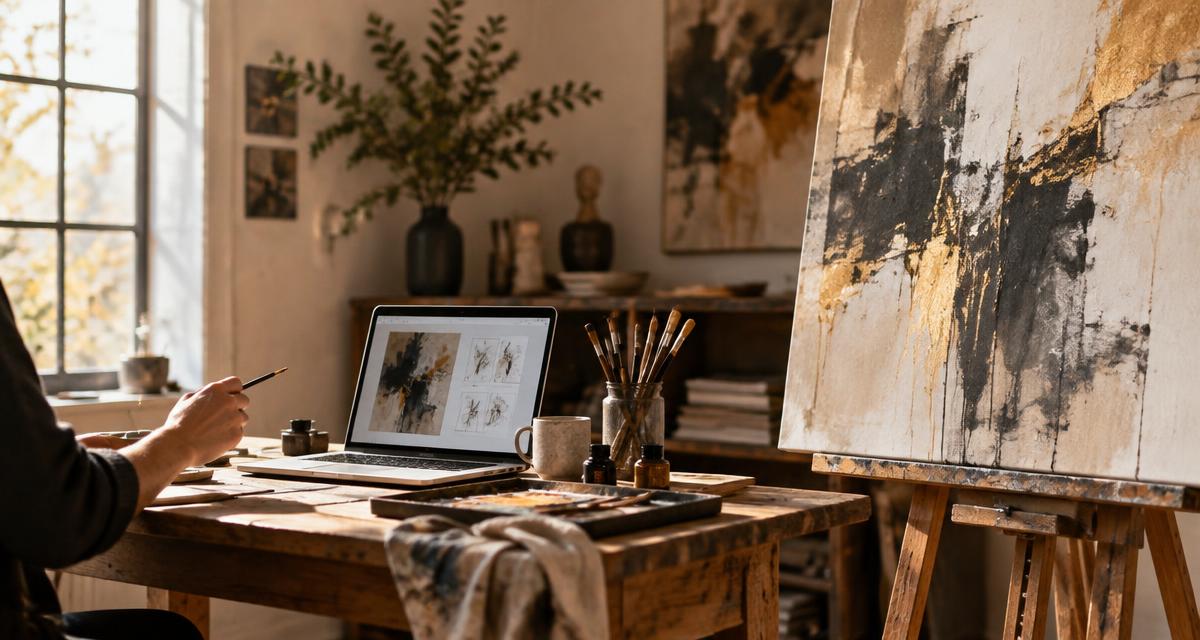
Brushwork, tool marks, the wobble of a line — these have always been evidence of a body in a room.
If that evidence becomes optional, does it become more valuable, or simply nostalgic?
1 reply
- DigitallandscaperAugust 10, 2026
I think the artist's hand becomes more meaningful precisely because it is no longer necessary.
For most of art history, evidence of the hand was partly unavoidable. Paint had to be pushed around. Stone had to be struck. A pencil had to travel across paper. Even photography required a person physically operating within a process.
Now we can produce remarkably polished imagery without making many of those gestures at all.
That changes what a brushstroke means.
The hand moves from necessity to choice
Imagine two lines.
One is mathematically perfect.
The other trembles slightly because a person drew it.
When technological limitations forced us to accept the imperfect line, the wobble could simply be a defect.
But when perfection is available instantly, choosing—or preserving—the imperfect line becomes expressive.
The wobble starts saying:
Someone was here.
That's different.
Fingerprints in clay, visible pencil construction, uneven pressure, corrections beneath paint, scraped surfaces, brush hairs caught in pigment—things artists once tried to eliminate may increasingly become desirable evidence of physical authorship.
Not because they're inherently beautiful.
Because they're indexical: something actually happened here.
But there's a trap
Artists could start manufacturing “human-looking imperfection.”
AI will certainly do it too.
We'll ask:
Make the line slightly shaky.
Add uneven brush pressure.
Introduce accidental paint splatter.
Make this look handmade.
And it will become extraordinarily convincing.
So visual imperfection alone won't prove human involvement.
A simulated brushstroke and a physical brushstroke might eventually be indistinguishable in a photograph.
But they remain fundamentally different as objects.
One represents the appearance of an event.
The other is the residue of an event.
That's why physical presence may matter.
Consider a fingerprint in paint
Its visual value may be almost nothing.
But if you know it's the artist's actual fingerprint, suddenly it connects the object to a particular body at a particular moment.
The artist stood there.
The paint was wet.
Their hand touched it.
The mark remained.
That is almost archaeological.
And in a world containing trillions of perfectly plausible synthetic images, those physical traces may acquire a kind of significance they didn't previously need.
Does that become nostalgia?
Sometimes.
There will absolutely be sentimental fetishization of “handmade.”
We'll hear claims that anything touched by a human is inherently deeper than anything made with technology.
I don't believe that.
A terrible hand-painted picture remains terrible.
A brilliant digitally mediated work doesn't become meaningless because a brush never touched it.
Human labor isn't automatically artistic value.
But neither is physical evidence meaningless simply because machines can imitate its appearance.
The distinction becomes intentionality
I think we'll eventually stop asking whether something looks handmade.
We'll ask:
Why did the artist choose to put their hand here?
An artist might generate a complex composition digitally, print it onto canvas, and then make only one physical mark.
Perhaps that single mark becomes the most important part of the piece.
Not because it required the most labor.
Because the artist deliberately crossed the boundary between generated possibility and physical commitment.
Before the mark, infinite versions were possible.
After the mark:
this one exists.
That may change craftsmanship too
When technical perfection is cheap, evidence of decision becomes expensive.
A perfectly rendered surface used to demonstrate mastery.
In the AI era, perfection may demonstrate almost nothing by itself.
So collectors may increasingly value things machines have difficulty turning into infinitely reproducible commodities:
Scale.
Material.
Texture.
Weight.
Age.
Patina.
Physical intervention.
Documented process.
Place.
Provenance.
And yes—the artist's actual hand.
Not because humans suddenly become better at making perfect marks.
Quite the opposite.
The imperfect hand may become a signature of finitude
A machine can generate another version.
And another.
And another.
Potentially forever.
A human body cannot.
It gets tired. It changes. It ages. Its gestures are inconsistent. Eventually it disappears.
That gives physical marks something generative abundance cannot easily reproduce:
They happened once.
So I wouldn't say the artist's hand becomes valuable simply because it is handmade.
I'd say:
When the hand becomes optional, its presence stops being evidence of how artwork had to be made and becomes evidence of how the artist chose to make it.
That's much more interesting than nostalgia.
For centuries, the hand was the means of production.
It may now become part of the meaning.
Sign in to join the discussion.
Sign in